
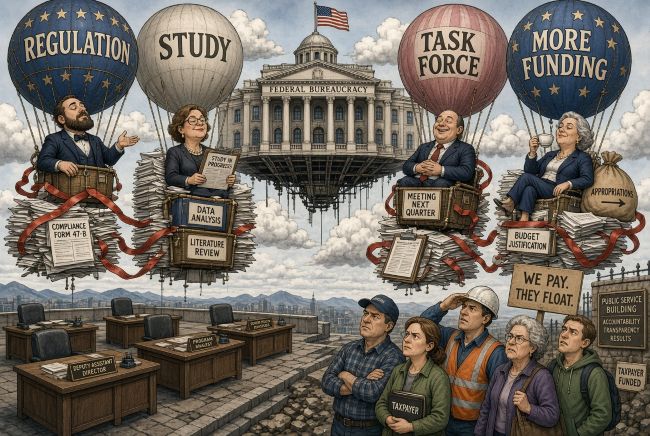
Look around the commanding heights of American life and a pattern jumps out. The people who talk the loudest, credential the hardest, and claim the most influence are often the ones who deliver the least. Journalists, bureaucrats, politicians, consultants, and corporate types inflate their own importance while the actual results—crime rates, border control, inflation, energy costs, school performance, basic competence—go the other way. They’re full of hot air. The rest of us get the bill.
This isn’t a new observation. The Peter Principle (people rise to their level of incompetence) has been around for decades. Dunning-Kruger (the least competent overestimate themselves the most) is well-documented. What feels new is how thoroughly the system now selects for and rewards the hot-air class while punishing people who actually know what they’re doing.
Media: Performance Over Substance
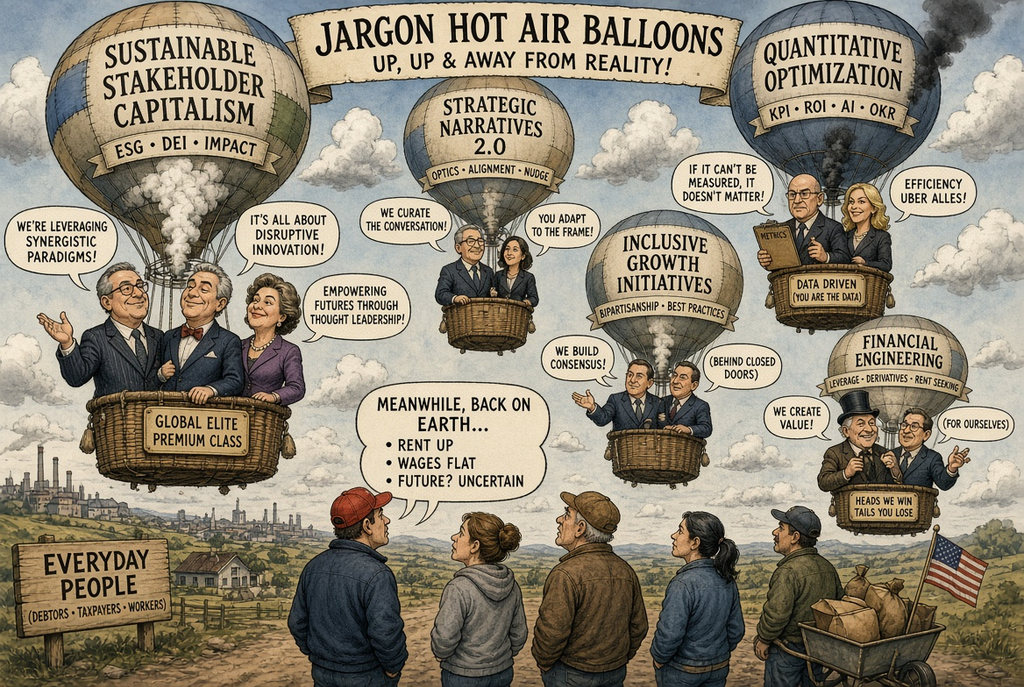
Legacy media and much of the online commentariat run on a simple incentive: maximize engagement and status within the guild. Accuracy and usefulness are secondary. A reporter who soft-pedals a story that embarrasses the preferred team keeps the access and the cocktail invitations. One who reports uncomfortable facts risks the pile-on.
The result is a permanent class of people whose entire product is narrative. They don’t build, fix, or measure outcomes. They “frame,” “contextualize,” and declare what “experts say.” When the narrative collides with reality (border numbers, crime stats, energy prices, school test scores), they either change the subject or attack the messenger. The self-importance is proportional to how little skin they have in the game. A columnist can be wrong for years and still collect a salary and prestige. A small-business owner who is wrong for months is out of business.
Government and Politics: No Skin in the Game, Plenty of Microphones
Politics and the administrative state amplify the problem. The people who write the rules, run the agencies, and appear on Sunday shows rarely face the direct consequences of their decisions. A failed energy policy, a botched foreign intervention, or an immigration system that collapses under its own weight does not usually end their careers. It often enhances them—more hearings, more books, more “thought leadership.”
Selection effects make it worse. The path into high office or senior bureaucracy rewards loyalty, credentials, and message discipline more than demonstrated results. Elite universities hand out the tickets. Soft fields and ideological conformity get you through the door; hard knowledge and willingness to contradict the room do not. Once inside, the Peter Principle does the rest: competent doers get promoted until they reach a level where talking and signaling matter more than delivering. At that point they stay, because the organization has no strong mechanism to remove them.
Business: When Signaling Replaces Performance
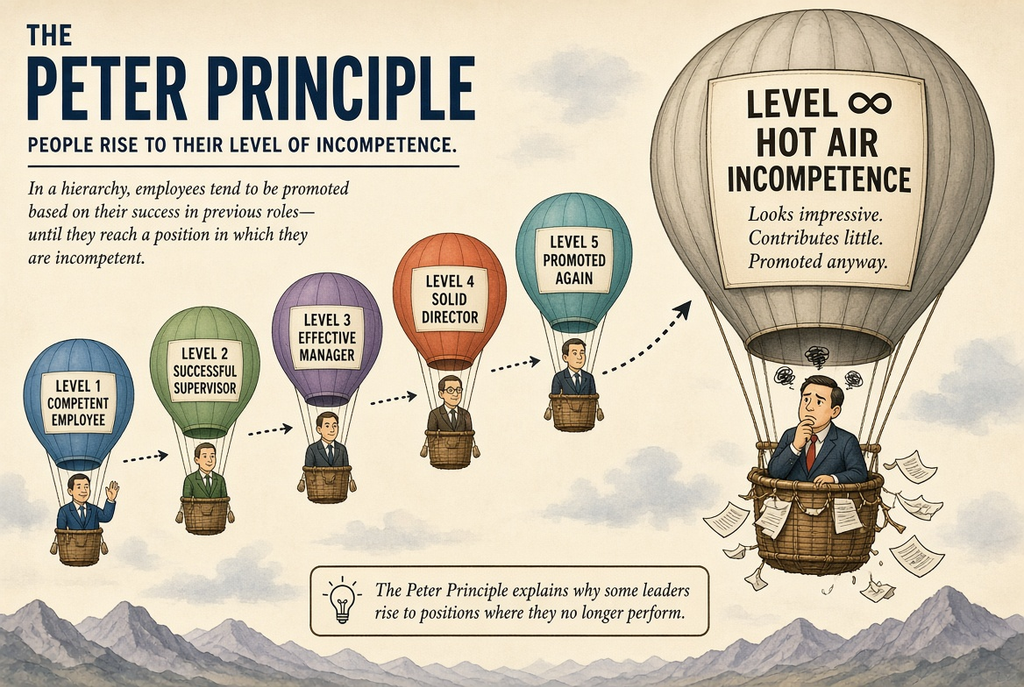
Large corporations are not immune. In competitive markets, pure hot air eventually loses. In sectors buffered by regulation, scale, government contracts, or fashion (ESG, DEI, “stakeholder capitalism”), the same dynamics appear. Executives and consultants who master the language of the moment rise. Those who insist on measuring actual results or hiring the most competent person regardless of checkboxes face headwinds.
The consultant class is especially pure. Entire industries exist to produce slide decks, frameworks, and jargon that sound important and change nothing. Their influence is real inside boardrooms and agencies; their track record on the ground is usually thin. They overinflate their importance precisely because the metric is not “did the thing work?” but “did the right people nod along?”
Why the Pattern Persists
Several forces keep the hot-air class in place:
- Credentialism over competence. A degree from the right school signals membership more than skill. Once credentialed, people are hard to dislodge even when results are poor.
- Incentive mismatch. Status, access, and money flow to those who talk well inside the system. Accountability is diffuse.
- Echo chambers and social punishment. Dissent from the dominant narrative is costly. People who notice that certain policies or institutions underperform learn to stay quiet or leave.
- Low personal cost of failure. When your livelihood does not depend on measurable outcomes for ordinary people, hot air is cheap and often profitable.
None of this means every person in media, government, or corporate life is useless. Plenty of competent operators exist. They are simply outnumbered and out-amplified by the ones whose comparative advantage is sounding important while producing little.

The Conservative Case for Skepticism
A healthy society needs experts, journalists, and administrators. It does not need a permanent aristocracy of people whose primary skill is inflating their own importance. Conservatives have long argued for markets, local control, and skin in the game precisely because those things discipline hot air. When people pay the price for being wrong, fewer of them stay wrong for long. When institutions are insulated from feedback, the opposite happens.
Ordinary Americans already sense this. They watch the same faces lecture them about complex systems those faces do not actually run well, then watch the results. The response has been rising skepticism of “experts,” declining trust in media and government, and preference for people who measure success by outcomes rather than by the volume of their rhetoric.
The hot-air brigade will keep talking. The question is how long the rest of the country keeps treating their self-importance as proof of competence. Results still matter. The people who produce them are usually quieter—and far more useful—than the ones floating above them on nothing but words.