
America is fighting over warehouses on farmland while Norway, Italy, and Pennsylvania already put servers inside the mountain. Vacant mines and quarries are not a stunt. They work.
Every month another town explodes over a proposed data center. The renderings look like a Home Depot designed by a Soviet architect. Neighbors hear “millions of gallons of water,” “constant hum,” and “industrial park next to the school.” Politicians split the difference: delay the project, lecture about AI, and leave the power problem for someone else.
Meanwhile, the obvious option sits empty under half of Appalachia and the Midwest: holes that miners already paid to dig.
This is not a thought experiment. Commercial data centers already run inside vacant mines, limestone caverns, Cold War bunkers, and — as of 2026 — an active quarry in the Italian Alps. The question is not “can you.” The question is why so many developers would rather fight a zoning war on cornfields than use rock that already exists.

Supercomputing goes underground at Norway’s Lefdal Mine Datacenter – DCD
Lefdal Mine Datacenter, Norway: former olivine mine, multi-level halls, fjord-water cooling.
The facilities that already exist
Start with the one that looks like a Bond villain set. Lefdal Mine Datacenter on Norway’s west coast occupies a former olivine mine 60 meters below sea level and hundreds of meters into the mountain. It opened as a data center in 2017. Halls sit on multiple levels; one level is described as 300 meters long with 14 “streets” off an “avenue.” Current build-out is already in the tens of megawatts, with dual grid connections expandable toward 200 MW and roughly 120,000 square meters of potential space.
Cooling is the trick everyone pretends is impossible until someone does it. Lefdal pulls ~8°C seawater from the adjacent fjord, runs it through heat exchangers, and supports air, direct-liquid, and immersion cooling. Reported PUE is in the 1.08–1.15 range. Power is cheap Norwegian hydro. Water usage effectiveness is near zero because they are not evaporating municipal water into the sky to look “green.”
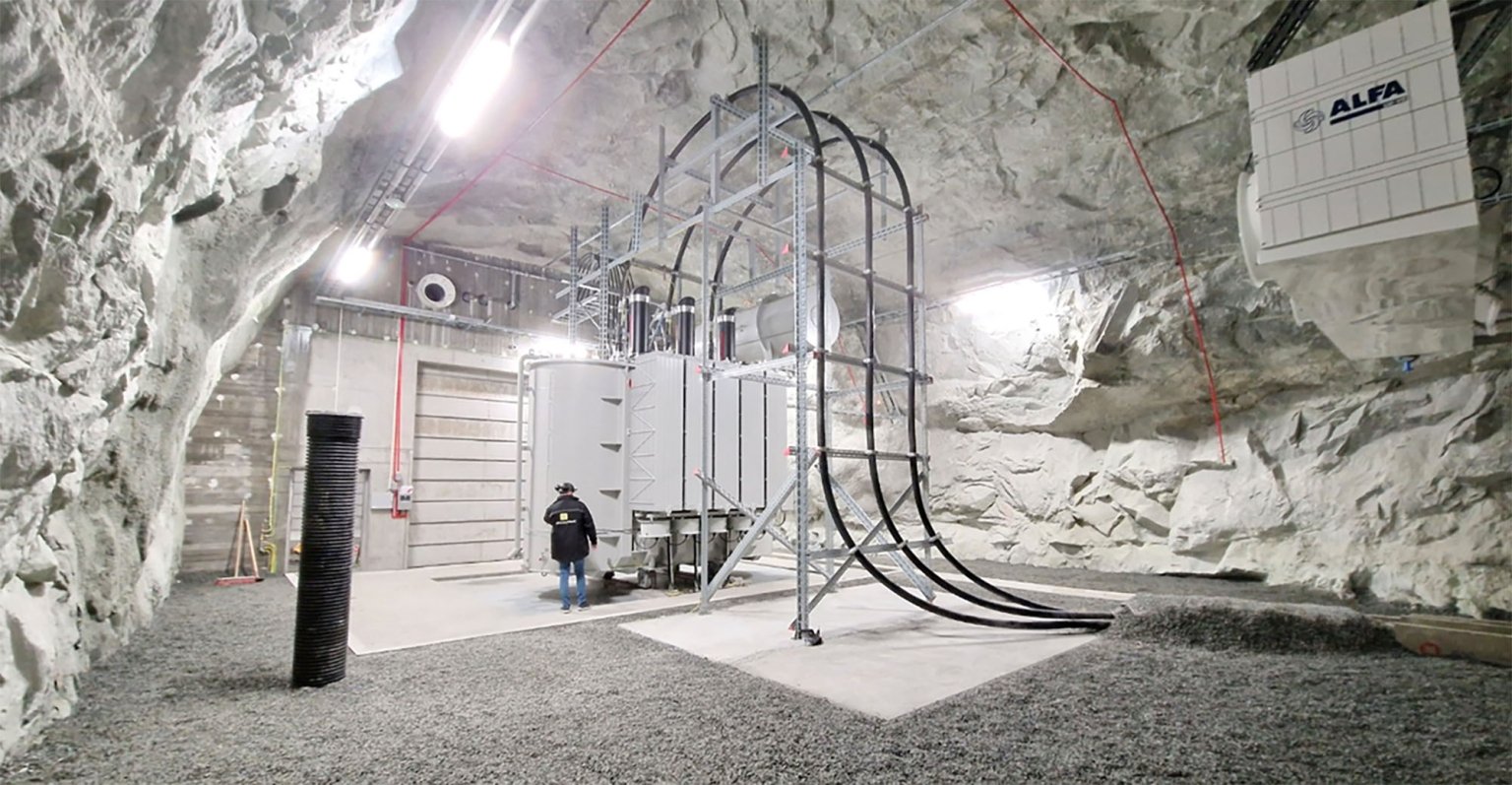
Lefdal Mine quadruples power capacity of underground data center – DCD
Transformers and cooling plant inside the mountain at Lefdal — power gear parked in its own rock hall.
Then there is Iron Mountain WPA-1 in Boyers, Pennsylvania — about an hour north of Pittsburgh. A former U.S. Steel limestone mine, 220 feet underground. Roughly 330,000 square feet of data-center space on a 200–315 acre campus, about 15.5 MW today with more headroom. Temperature in the rock stays in the mid-50s Fahrenheit. Cooling uses a large underground reservoir as a geothermal sink. The same complex stores federal records, film archives, and enough paper to keep conspiracy theorists employed for a decade. The point for operators is simpler: tornadoes do not follow you 22 stories down.

The portal at Iron Mountain, Boyers, PA. Behind that door: 220 feet of limestone and a data hall.
Italy went one step further. Intacture / Trentino DataMine opened in 2026 inside the Tuenetto di Predaia quarry in Val di Non — an active dolomite mine that still extracts rock while servers sit 100 meters underground next to rooms that have stored apples, sparkling wine, and cheese for decades. Capacity is in the 6 MW class. More than 80 percent of the plant is underground. The rock is dry. Ambient temperature is a constant 12°C. The operator claims zero water for cooling and 100 percent renewable power. Construction took a little over two years, including new tunnels and a vertical shaft. Cost: about €50 million, with a slice of EU recovery money.
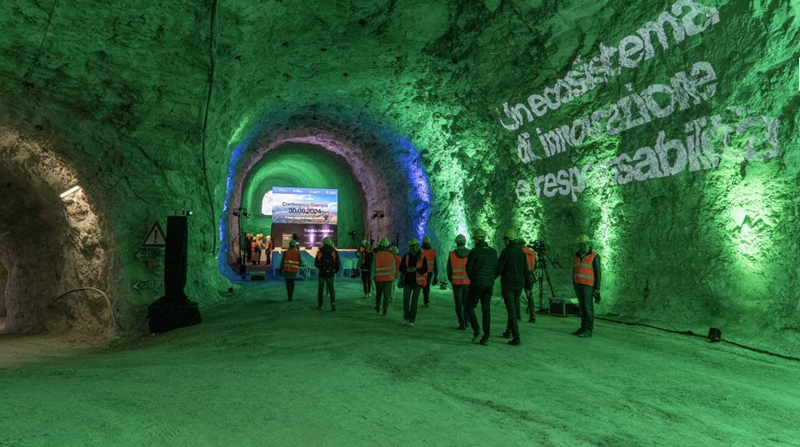
Green-lit dolomite tunnel at Intacture during commissioning.
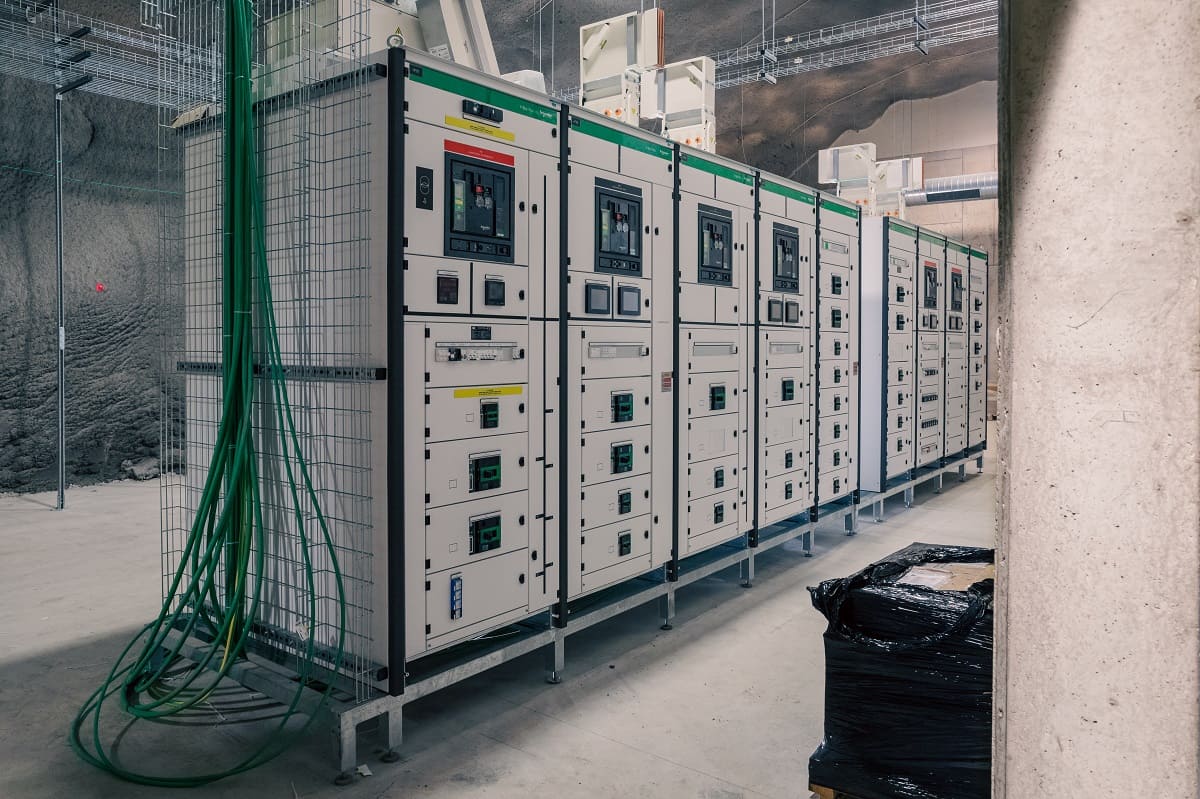
Data center in a Trentino mine, Intacture sets a new benchmark
That is not the whole list. Bluebird Underground in Springfield, Missouri sits about 85 feet down in a decommissioned limestone mine. SubTropolis in Kansas City is a room-and-pillar limestone complex measured in millions of square feet; Hunt Midwest markets a Technology Center there specifically for data halls, with claims of a powered shell in about 90 days. Sweden’s Bahnhof turned a Cold War bunker under Stockholm (Pionen) into a showpiece data center. Various smaller bunker conversions exist across Northern Europe.
Some West Virginia sites have hosted crypto-mining crates on abandoned coal ground. That is not the same thing as a Tier III hall inside competent rock — and it should not be sold as one — but it shows the land is already industrial.

The Story of SubTropolis & KC’s Limestone Caves — KC Yesterday
SubTropolis, Kansas City: limestone pillars, paved “streets,” climate that barely moves.

SubTropolis underground business complex | Hunt Midwest
Finished warehouse floor in the same complex. Data halls are a specialized version of this, not a different planet.
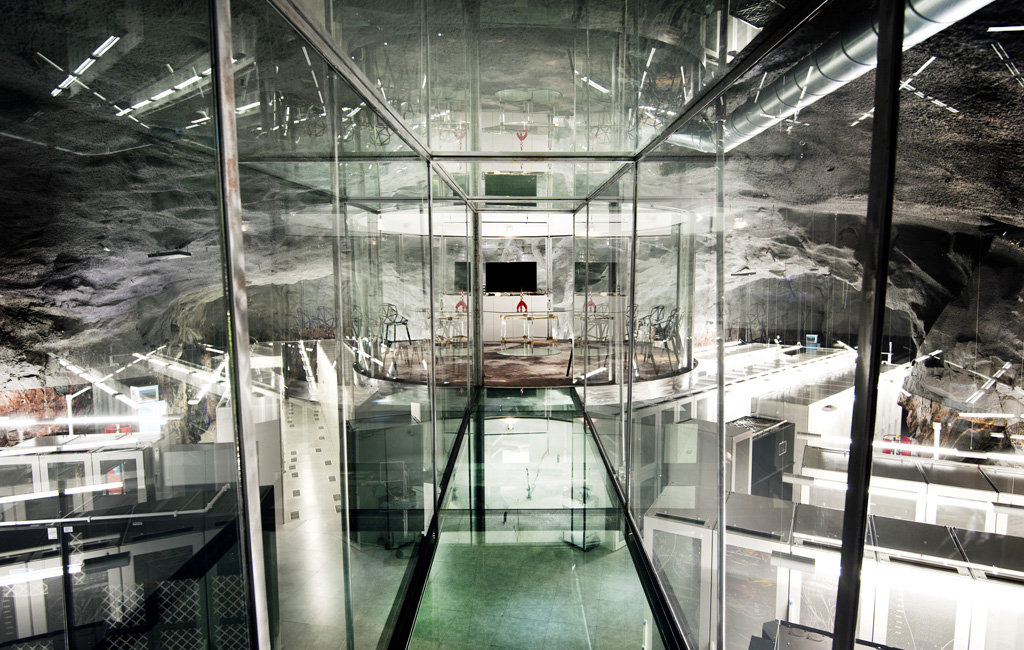
Sweden’s coolest data centre
Bahnhof Pionen, Stockholm: a civil-defense bunker turned into a glass-and-rock data hall.
Quarries are not a gimmick. They are a category.
“Quarry” covers two different things, and the difference matters.
- Underground / room-and-pillar stone operations (limestone, dolomite, some hard rock) leave large, regular halls. Those convert. Intacture is the live example of doing it while the quarry is still producing.
- Open-pit quarries are mostly a land play. Developers in places like Dauphin County, Pennsylvania have filed to put conventional one-story data halls on former quarry parcels. That reuses the site, not a cavern. Neighbors still see buildings, hear equipment, and fight the same water-and-power fight. Manchester Township, New Jersey, even stripped data centers out of a former sand-and-gravel quarry redevelopment plan after residents showed up.
Flooded pits and mine pools are a third option: not for putting racks in the water, but for using the cold pool as a heat sink. Studies on Pennsylvania abandoned mine lands have modeled pit pools supporting on the order of 10 MW of heat rejection with air cooling and roughly 30 MW with liquid cooling at a single site — with hundreds of candidate pools statewide if you only count the ones big enough to matter.
Israel has floated an underground hall in a disused Timna copper pit with solar on the surface. Australia’s Hunter Valley has been discussed the same way: mining voids, cooler rock, existing grid stubs. Virginia’s “Data Center Ridge” concept leans on billions of gallons of ~55°F mine water plus on-site generation.
The pattern is the same: stop pretending the only canvas is a greenfield next to a subdivision.
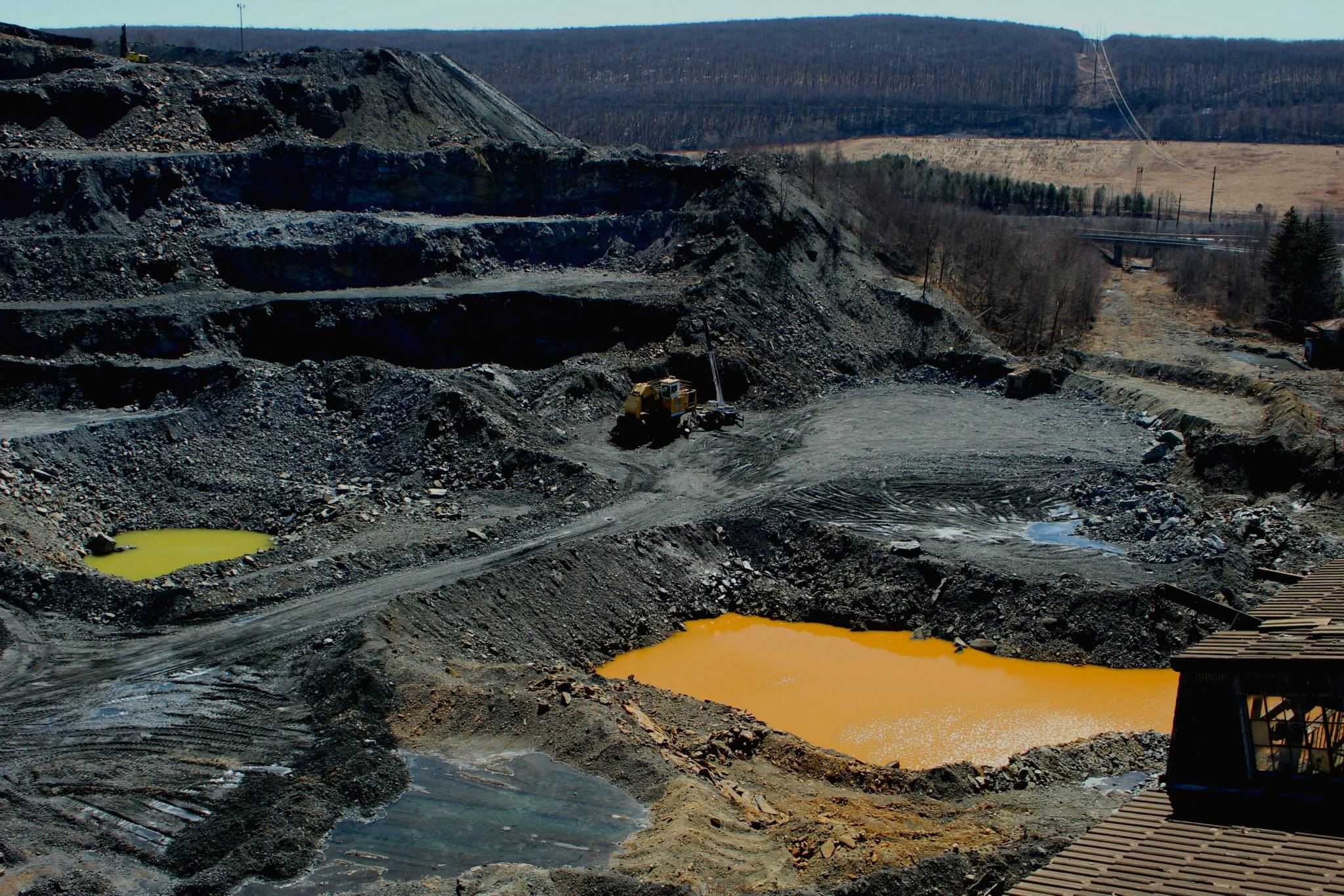
Legacy: abandoned mine impacts in Pennsylvania’s Appalachia – Uneven Earth
Typical Appalachian mine land: not every pit is a data hall. Some are water and liability. The usable ones still beat another cornfield fight.
Why the rock wins when the geology cooperates
Security that is not a PowerPoint slide. One or two controlled portals. Hundreds of feet of rock. Weather, most small-arms threats, and a lot of electromagnetic noise stay outside. That is why governments and regulated industries have used these sites for decades before anyone said “AI cluster.”
Temperature that does not care about August. Many limestone and hard-rock mines sit near 50–55°F year-round. Intacture’s dolomite is dry and 12°C. You still have to reject server heat — rock is an insulator, not a magic radiator — but you start from a stable basement instead of fighting a metal box in a Virginia heat wave.
Cooling water that is already there. Underground lakes, mine pools, fjords. Closed-loop heat exchangers keep raw mine water off the chips. Iron Mountain’s reservoir and Lefdal’s fjord are the working proofs. Coal-country mine pools in the 50–55°F range have been studied for the same job.
Less surface circus. Eighty percent underground, as in Italy, means the fight over “visual blight” gets a lot smaller. One line that keeps showing up in the trade press: nobody pickets a data center they cannot see.
Fit-out can be cheaper than a hardened above-ground box. The outer shell already exists. Operators who have done this talk about building an interior shell in months, not years, and spending a fraction of what a tornado-rated surface plant costs. Lefdal has said mine halls can come in well under a conventional concrete data hall. That is not free money — moisture control, radon, grounding, and fire systems still cost real dollars — but you are not pouring a new mountain.
Waste heat is a resource, not a press release. Projects in Germany and Scotland have looked at stuffing summer heat from campus data halls into abandoned mine workings and pulling it back in winter for district heat. That is actual circular use, not a rooftop garden on a diesel farm.
Why this is still a niche — and why coal mines are not limestone mines
If it were easy, every hyperscaler would already be doing it. The constraints are real.
Geology is not optional. Limestone and competent hard rock with room-and-pillar layouts are the sweet spot: large, relatively dry, predictable halls. Many coal mines are wet, acidic, unstable, or poorly mapped. Acid mine drainage is not a cooling feature. Subsidence under a surface campus is not a punchline. Anyone proposing “just put it in an old coal mine” without a geotechnical package is selling a brochure.
Power and fiber still rule. A pretty cavern 80 miles from a 138 kV line and a long-haul fiber hut is a museum. Interconnection queues are the same bottleneck they are on the surface. Some mine sites already have industrial substations and rail. Many do not.
Heat still has to leave. Surrounding rock does not swallow megawatts. You need ventilation, liquid loops, or a surface heat-rejection plant. Humidity, smoke extraction, and generator-fuel storage in an enclosed volume are specialized problems. Bluebird had to drive grounding electrodes hundreds of feet down to the water table because limestone does not conduct like a copper rod in dirt.
Expansion is a drill-and-blast decision. On a greenfield you add another metal box. Underground you excavate another hall or accept the footprint you have. That is fine for a planned campus. It is death for a company that sells “we will double next year.”
Lawyers and leftover liability. Abandoned mine lands come with environmental statutes, incomplete maps, and municipalities whose zoning code still thinks “data center” is a typo. Pennsylvania has thousands of abandoned mines and almost no data halls inside old coal workings. Surface reuse of mine land is moving faster than true underground conversion, which tells you where the friction is.
Inventory is limited. There are a lot of holes in the ground. There are far fewer holes that are dry, stable, large, close to megawatts and fiber, and clean enough to insure. That is the actual scarcity, not imagination.
New construction underground is possible. It is usually the expensive way.
You can blast new caverns. Intacture did substantial new excavation inside a working quarry. Purpose-building a buried box from a greenfield shaft is different: you pay for the rock removal and the lining and lose the cost advantage that made the mine attractive. If the only goal is “hide the ugly building,” a berm and a good landscape architect are cheaper than a mountain.
The rational version of “new construction” is: take a proven void, enlarge it, add a shaft, and treat the rock as the building. That is reuse plus civil works, not a science project.
What a serious American program would look like
Not a slogan. A filter.
- Prefer limestone and hard-rock room-and-pillar mines over coal workings for occupied halls.
- Use coal-country mine pools and open pits for cooling water and surface campuses, not as a fantasy server cave.
- Require a geotechnical, hydrology, and air-quality package before anyone files a press release.
- Collocate with existing transmission and dark fiber, or admit the project is a 7–10 year grid wait like every other hyperscale site.
- Treat waste heat and mine-water loops as design requirements, not ESG garnish.
- Stop using “abandoned mine” as a synonym for “free land next to a town that already lost the coal jobs.” Some of those sites are assets. Some are Superfund with extra steps.
Pennsylvania, West Virginia, Virginia, Missouri, Kansas, and parts of the West already have the holes. Norway and Italy already have the operating manuals. The United States does not have a geology problem. It has a habit of building the same metal box on the last remaining field and then acting shocked when the neighbors show up with signs.
The short version
Yes, you can build data centers underground in vacant mines. Yes, quarries count — either as caverns or as industrial land with a pit full of cold water. Yes, you can excavate new space if the rock is right. It is already being done at megawatt scale, with fjord water, underground lakes, and dry alpine stone doing the work that evaporative towers do on the surface.
It is not a universal answer. Wet coal mines, remote holes with no grid, and developers who want infinite cheap expansion will keep pouring slabs in the sun. For everyone else, the next “campus” does not have to flatten another township. The mountain is already hollow.