
In the early hours of January 3, 2026, the geopolitical landscape of Latin America shifted dramatically. U.S. military forces launched a series of precision airstrikes on key targets in northern Venezuela, culminating in the capture of President Nicolás Maduro and his wife, Cilia Flores. This operation, codenamed “Absolute Resolve,” marked a bold and controversial assertion of U.S. power in the region, echoing historical interventions while raising fresh questions about international law, sovereignty, and America’s role in the world. President Donald Trump announced the success of the mission on Truth Social, stating that Maduro had been “captured and flown out” of the country, and that the U.S. would temporarily “run” Venezuela to facilitate a transition. This blog post delves into the background, execution, aftermath, and global implications of this unprecedented event.
Background: A Simmering Crisis in Venezuela
Venezuela’s descent into chaos has been years in the making. Once one of South America’s wealthiest nations due to its vast oil reserves—the largest proven reserves in the world—the country has been plagued by economic collapse, hyperinflation, and political repression under Maduro’s rule. Maduro, who assumed power in 2013 following the death of Hugo Chávez, has faced accusations of authoritarianism, election fraud, and ties to narcotrafficking.
The tipping point came with the July 2024 presidential election, widely regarded as fraudulent by international observers. Opposition leader María Corina Machado claimed victory, but Maduro’s regime manipulated results to retain control, leading to widespread protests and a brutal crackdown. Over 2,000 people were arrested, and at least 25 killed in the ensuing repression. The U.S., under both the Biden and Trump administrations, imposed stringent sanctions on Venezuela’s oil sector and designated Maduro-linked entities, including the “Cartel of the Suns,” as terrorist organizations.
Tensions escalated in 2025 as the Trump administration ramped up pressure. In August, the U.S. began a military buildup in the southern Caribbean, deploying warships and personnel. By September, strikes targeted vessels allegedly trafficking drugs on behalf of the Venezuelan regime. Secret talks between U.S. officials and Venezuelan opposition figures, including Machado’s promise to open oil reserves to American companies, further fueled speculation of intervention. Maduro’s alliances with Russia, China, and Iran—providing economic and military support—positioned Venezuela as a flashpoint in great-power competition.
Trump’s rhetoric grew increasingly aggressive, framing Maduro as a “narco-terrorist” who had “deployed cocaine as a weapon” against the U.S. A 2020 U.S. federal indictment charged Maduro with narcoterrorism, and the reward for his capture was doubled to $50 million in 2025. By December, U.S. forces were positioned, and covert CIA operations tracked Maduro’s movements. Trinidad and Tobago granted U.S. military access to its airports, setting the stage for the strike.
The Operation: Precision and Audacity
Operation Absolute Resolve commenced on January 3, 2026, at 02:01 VET (Venezuela Time). Planned by the U.S. Department of Defense and commanded directly by President Trump, the mission involved over 150 aircraft, including F-22 Raptors, F-35 Lightning IIs, B-1 Lancers, and AH-64 Apache helicopters. Strikes targeted military installations such as the Generalissimo Francisco de Miranda Air Base, Fort Tiuna, Higuerote Airport, and La Guaira port, as well as infrastructure in urban areas like Caracas, La Guaira, and Baruta.
The operation unfolded under cover of darkness, with power outages engineered in parts of Caracas to disrupt communications. U.S. Army Delta Force, supported by the 160th Special Operations Aviation Regiment and FBI Hostage Rescue Team, raided Maduro’s compound. Maduro and Flores were arrested without major resistance and extracted via helicopter to the USS Iwo Jima. By 05:21 VET, Trump confirmed their capture on social media.
Casualties were relatively low: Two U.S. soldiers sustained non-life-threatening injuries (one from a bullet, one from shrapnel), and one helicopter was damaged. On the Venezuelan side, at least 40 military personnel and civilians were killed, including in strikes that hit urban areas like a civilian apartment complex in Catia La Mar. Trump claimed Cuban forces protecting Maduro also suffered losses, though numbers remain unconfirmed.
The raid’s success highlighted U.S. military superiority in “decapitation” strikes—targeting leadership to dismantle regimes quickly, as seen in previous operations against figures like Qasem Soleimani. Maduro and Flores were flown to Stewart Air National Guard Base in New York by 18:00 VET, where they were processed for trial in the Southern District of New York on charges including narcoterrorism, cocaine importation, and possession of machine guns.

Aftermath: Power Vacuum and U.S. Control
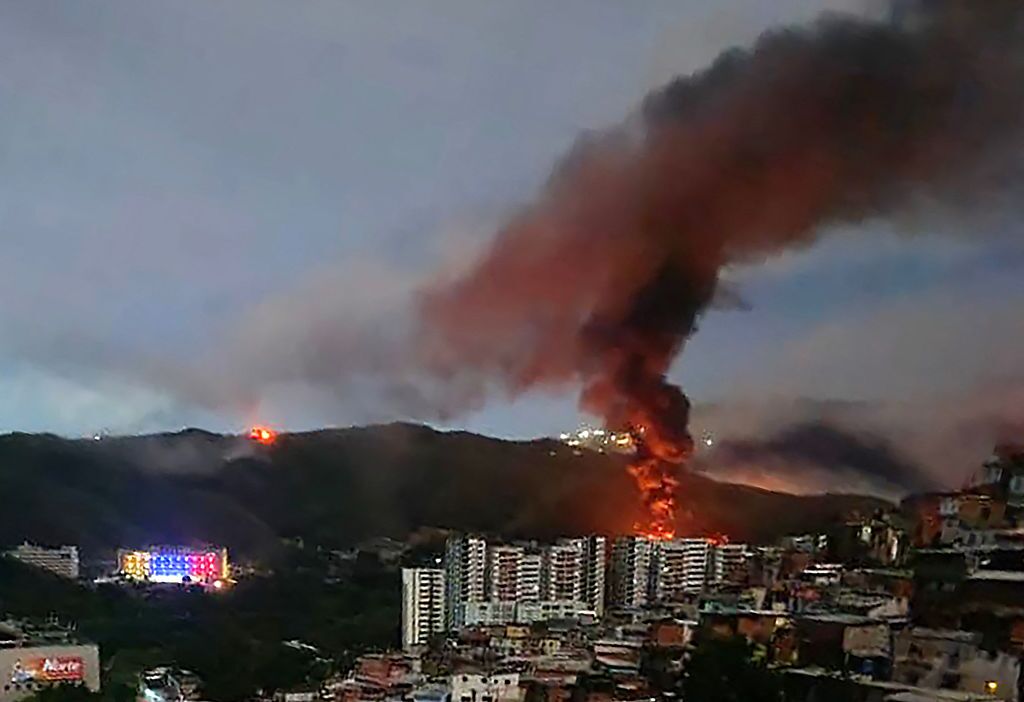
In the immediate aftermath, Venezuela’s government declared a state of emergency. The Supreme Court of Justice ordered Vice President Delcy Rodríguez to assume the presidency, insisting the regime remained intact despite Maduro’s removal. Explosions rocked Caracas, with reports of power outages and chaos in the streets. The U.S. FAA prohibited flights over Venezuelan airspace, and the American embassy issued shelter-in-place orders.
Trump outlined a vision for U.S. stewardship, stating American oil companies would invest billions to rebuild Venezuela’s infrastructure and sell its oil globally during the transition. He invoked a modernized “Donroe Doctrine” (a play on the Monroe Doctrine), emphasizing U.S. dominance in the Western Hemisphere. Vice President JD Vance and Secretary of Defense Pete Hegseth echoed this, promising to return “stolen oil” and facilitate investments.
However, Maduro’s allies, including armed colectivos and potential insurgent groups like the ELN, could exploit the vacuum, risking prolonged instability. Venezuelans, many of whom have suffered under Maduro’s rule—with nearly 8 million fleeing the country—expressed mixed relief and apprehension.
Global and Domestic Reactions
The action drew sharp international condemnation. Russia, China, Iran, Cuba, Mexico, Brazil, and others labeled it a violation of sovereignty and international law, with UN experts calling for Trump’s impeachment. UN Secretary-General António Guterres termed it a “dangerous precedent,” scheduling a Security Council meeting for January 5. Supporters, including Israel, Argentina, and Albania, praised it as a blow against dictatorship.
In the U.S., reactions split along partisan lines. Republicans like Senator Marco Rubio hailed it as necessary for national security, while Democrats, including Senators Brian Schatz and Tim Kaine, decried it as illegal and unauthorized by Congress. Legal experts questioned its constitutionality, comparing it to past interventions like Panama (1989) and Iraq (2003).
On social media platform X, reactions ranged from celebration among Venezuelan expatriates to outrage over perceived imperialism. One user noted the irony of Trump’s use of indictments against Maduro while decrying his own legal battles. Others speculated on broader implications, such as disrupting Russian influence in the region.
Implications: Oil, Hegemony, and the Future
This intervention underscores Trump’s “America First” approach, prioritizing resource control and countering adversaries. By tapping Venezuela’s oil, the U.S. could stabilize global energy markets and reduce reliance on hostile suppliers. However, it risks alienating Latin American allies and emboldening rivals like China in other regions.
For Venezuela, the removal of Maduro offers hope for democracy but could lead to factional violence if the transition falters. The International Criminal Court’s ongoing probe into Maduro-era crimes against humanity may expand, ensuring accountability.
In a world of shifting alliances, this event revives debates on unilateralism versus multilateralism. As Trump put it, “We are reasserting American power.” Whether this leads to stability or escalation remains to be seen.
