
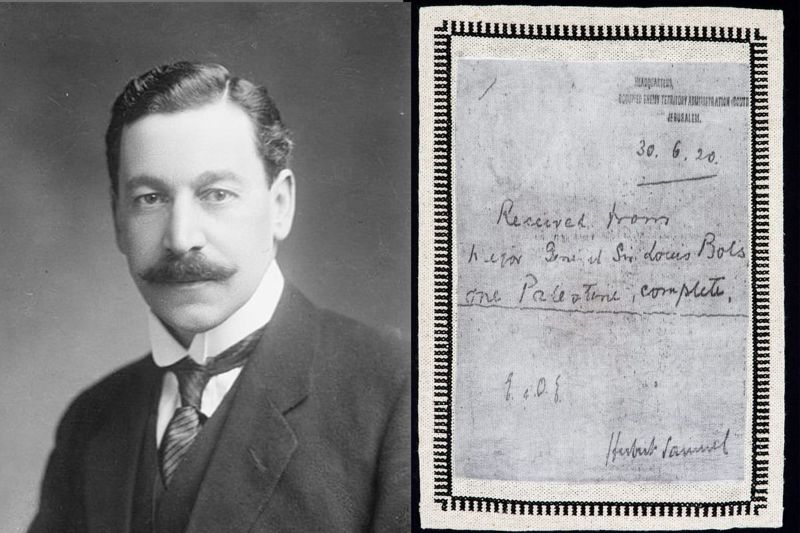
For decades, the world has been fed a relentless narrative: that a peaceful Arab nation called Palestine existed for centuries until it was violently “occupied” or “stolen” in 1948. This story fuels protests, UN resolutions, academic papers, and endless media coverage.
It is a lie.
There has never been an independent, sovereign country called Palestine — not under Arab rule, not under any other indigenous governance, not with defined borders, a national government, currency, army, or foreign policy of its own. The name “Palestine” has a long geographic history, but it was never a political state until modern political invention turned it into one.
Here’s the documented history that dismantles the myth.
The Name “Palestine” Was a Roman Punishment, Not a Nation
The earliest uses of names like “Palaestina” referred to the ancient Philistines, a seafaring people who disappeared from history long before the Common Era. The Romans, after crushing the Jewish Bar Kokhba revolt in 132–136 CE, deliberately renamed the province of Judea as Syria Palaestina. Their goal was explicit: to erase the Jewish connection to the land and punish the Jews by associating it with their ancient enemies, the Philistines.
No Arab state, no Palestinian kingdom, no sovereign entity by that name ever existed before or after. The region passed through empires — Jewish kingdoms, Assyrian, Babylonian, Persian, Greek, Roman, Byzantine, early Islamic, Crusader, Mamluk, and Ottoman — but never as an independent “Palestine.”
Ottoman Territorial Reorganization, 1840-1917 | Interactive Encyclopedia of the Palestine Question – palquest
Ottoman administrative map showing the Levant divided into sanjaks and vilayets. Notice: no single entity called “Palestine.” The area was carved into districts (including Jerusalem, Nablus, and Acre) under larger Ottoman Syrian structures. It was never a unified country.
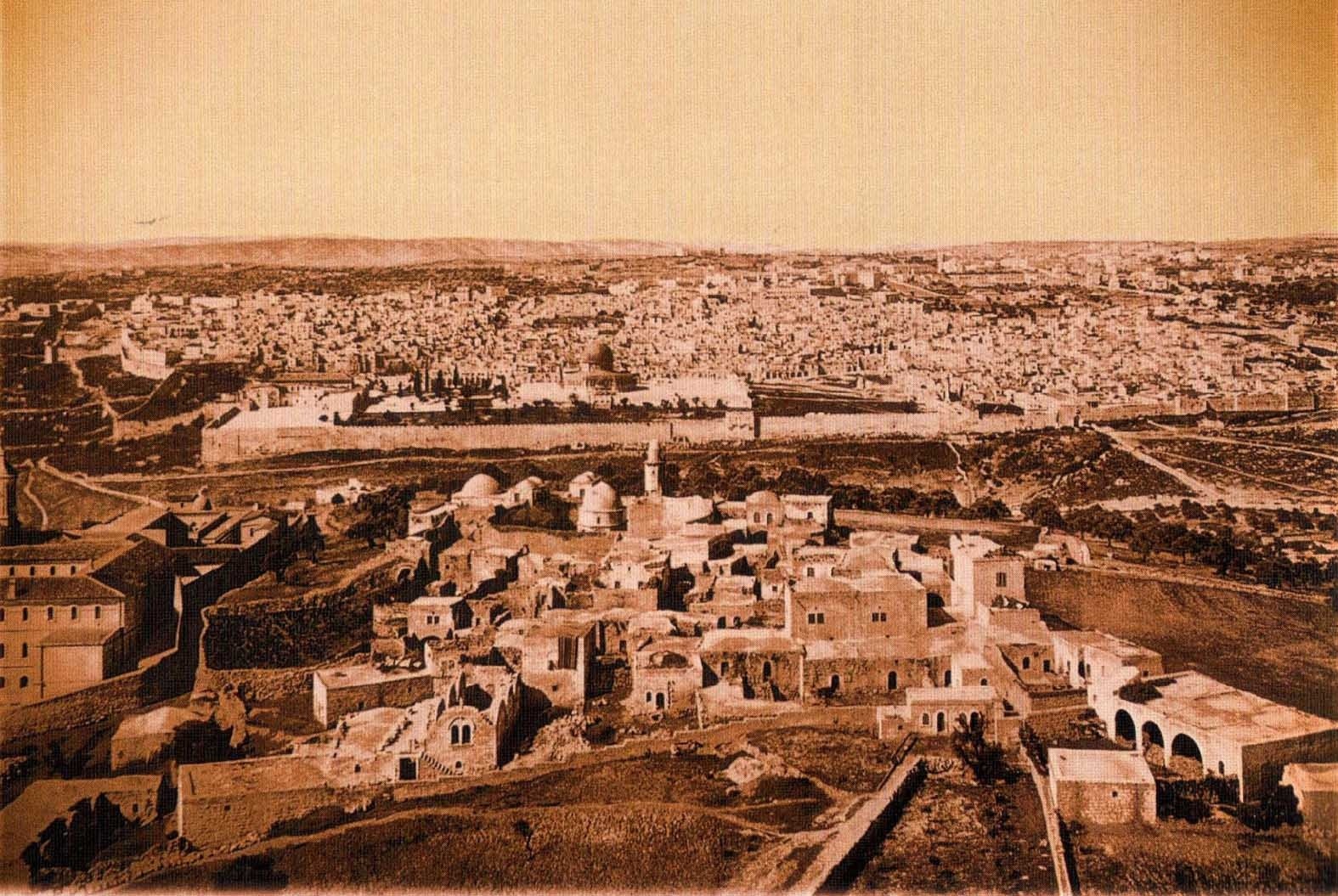
19th-century photograph of Jerusalem under Ottoman rule. The land existed. People lived there. But it was not a nation called Palestine — it was part of the Ottoman Empire, with local Arabs identifying primarily as Muslims, Christians, or subjects of the Sultan, often seeing themselves as southern Syrians.
The British Mandate: Temporary Administration, Not a Country
After World War I, the League of Nations gave Britain the Mandate for Palestine (1920–1948). This was not an independent state. It was a temporary trusteeship to administer the former Ottoman territory and, per the Balfour Declaration incorporated into the Mandate, to facilitate a “national home for the Jewish people.”
The British themselves separated Transjordan (later Jordan) from the western part. The name “Palestine” was simply the administrative label they inherited and used on stamps, coins, and documents. It did not create a Palestinian nation-state. All other League of Nations mandates in the region eventually became independent countries. Palestine did not — because no such sovereign entity was ever established.

lIsrael’s Origins and Evolution (Biblical, 1920-1948, 1947, 1949-67, June 1967) | Library of Congress
Historical evolution maps (from biblical times through the British Mandate 1920–48 and the 1947 UN Partition Plan). These visuals make the reality clear: the land changed hands through conquest and administration. No Palestinian state appears because none existed.
1947–1948: The UN Offered an Arab State — Arabs Rejected It and Lost the War They Started
In 1947, the United Nations proposed partitioning the British Mandate into two states: one Jewish and one Arab (Resolution 181). Jerusalem was to be internationalized. The Jewish leadership accepted the plan despite getting less land than hoped. Arab leaders rejected it outright and launched a war to prevent any Jewish state.
When Israel declared independence in May 1948, five Arab armies invaded. Israel survived and expanded its territory in the fighting. Jordan annexed the West Bank. Egypt took Gaza. No Palestinian Arab state was created — because the Arab side had rejected the very idea and then lost the war they initiated. the 1947 UN Partition Resolution Must Be Celebrated | The Washington Institute
1947 UN Partition Plan map. The green/teal areas show the proposed Jewish state; orange the proposed Arab state. The Arab leadership said no — and chose war instead.
Palestinian Nationalism Is a 20th-Century Political Creation
Before the 1920s–1930s, the local Arab population did not widely identify as a distinct “Palestinian nation” with a claim to exclusive sovereignty over the entire land. They were Arabs living in southern Syria or Ottoman districts. Prominent Arab leaders in the 1930s and 1940s openly described “Palestine” as southern Syria.
The modern Palestinian national movement crystallized largely in response to Zionism and after the 1948 and 1967 wars. The PLO was founded in 1964 — 16 years after Israel’s founding — with a charter calling for the destruction of Israel and the “liberation of Palestine” (meaning all territory west of the Jordan River). In 1988 the PLO declared a “State of Palestine” from Algiers, but it controlled zero territory at the time.
Today’s “Palestine”: Limited Autonomy, Not a Sovereign Country
The Palestinian Authority (created by the 1993–1994 Oslo Accords) exercises limited self-rule in parts of the West Bank (Areas A and B). Hamas seized Gaza in 2007 and runs it as a theocratic dictatorship. Neither has full sovereignty:
- No control over borders or airspace
- No independent military or foreign policy
- No unified government (Fatah vs. Hamas split since 2007)
- Uses Israeli shekels and other currencies
- Relies on Israeli security cooperation in many areas
The entity has UN non-member observer status (since 2012) and diplomatic recognition from many countries, but it does not function as a normal sovereign state. The “State of Palestine” proclaimed in 1988 remains largely a political and diplomatic construct, not a realized country on the ground.
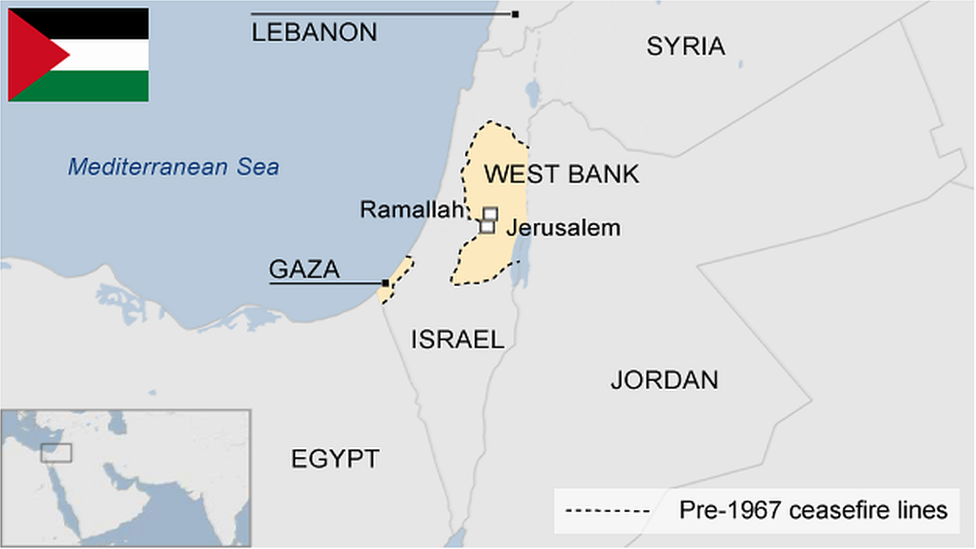
Modern map of the region showing Israel, the West Bank, Gaza, and pre-1967 lines. The fragmented control and lack of full sovereignty are visible realities, not “occupation of an existing country.”
Why This Matters
The claim that Israel “stole Palestine” or that Jews are settler-colonial occupiers on indigenous Palestinian land collapses under historical scrutiny. The Jewish people maintained a continuous presence in the land for over 3,000 years, with documented kingdoms, temples, coins, inscriptions, and religious centrality unmatched by any other group. Arabs conquered the region in the 7th century as part of Islamic expansion.
The “Palestine” narrative that dominates campuses, media, and international forums is a powerful political myth built on selective history and convenient amnesia. It erases the Jewish indigenous connection, ignores Arab rejectionism of every partition and peace offer, and pretends a sovereign nation-state existed where none ever did.
History is not a weapon, but facts are stubborn. There was never a country called Palestine to “liberate.” There were empires, mandates, wars, and competing national claims over a small, strategically vital piece of land. One side built a thriving nation-state. The other side has yet to do the same.
The path to peace begins with honesty about the past — not with repeating a myth that never happened.