
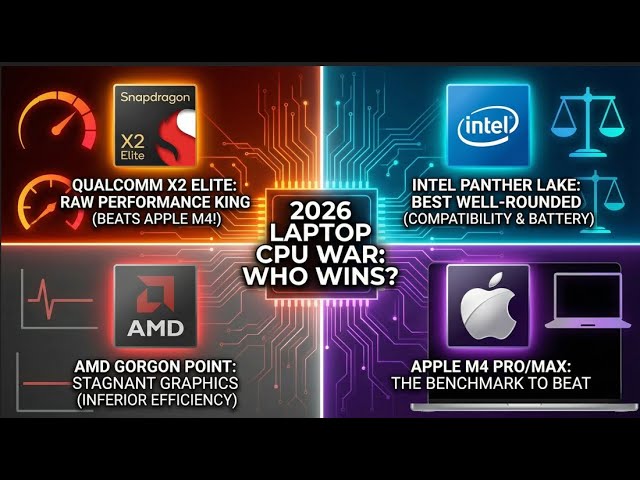
The year 2026 is shaping up to be one of the most exciting in laptop history. AI is no longer a cloud gimmick—it’s running locally on-device with massive NPU gains, while efficiency, graphics, and battery life are leaping forward thanks to new process nodes and architectures. Whether you’re a creator chasing on-device LLMs, a gamer hunting portable power, or just someone who wants all-day battery without compromise, the major players (Intel, AMD, Qualcomm, and Apple) are all dropping major hardware in 2026.
Here’s a deep dive into the key chips powering next-gen laptops, based on official launches, roadmaps, and early benchmarks as of early 2026.
Intel Core Ultra 300 “Panther Lake” – The 18A AI Powerhouse (Launched Q1 2026)
Intel’s Core Ultra Series 3 (codenamed Panther Lake) officially debuted at CES 2026 in January and started shipping in laptops by January 27. While earlier roadmaps pointed to a Q2 window, Intel accelerated production on its Intel 18A (2nm-class) process—the first client SoC built on this advanced node with RibbonFET transistors and PowerVia backside power delivery.
Key Specs & Highlights
- CPU: Up to 16 cores in flagship SKUs (configurations like 4 Performance + 8 Efficient + 4 Low-Power Efficient cores). Top models (e.g., Core Ultra X9 388H) hit 5.1 GHz boost.
- NPU: New 5th-gen NPU delivers 50 TOPS standalone. Combined with the GPU, total platform AI performance reaches up to 170–180 TOPS.
- GPU: Arc Xe3 graphics with up to 12 Xe-cores (branded Arc B390 in premium SKUs). Intel claims up to 77% faster gaming performance vs. Lunar Lake’s Arc 140V and 60% better multithreaded CPU performance at similar power.
- Efficiency: Up to 27 hours of video playback in some designs, plus strong claims in AI workloads (1.9× LLM performance, 4.5× vision-language-action throughput).
- TDP Range: 25W–80W+ variants for thin-and-lights to high-performance machines.
Panther Lake shines in AI PCs (Copilot+ certified), creative workloads, and even gaming laptops thanks to the beefy integrated graphics. Early reviews call it Intel’s strongest laptop CPU in years, especially in multi-core and graphics-heavy tasks. Expect it in premium ultrabooks from ASUS, MSI, Acer, Samsung, and more throughout the first half of 2026.
AMD Medusa Ryzen Series – Zen 6 AI Tuned for Q2 2026
AMD’s Medusa (often referred to as Medusa Point or Medusa APUs) is the mobile half of the Zen 6 generation. Roadmaps from partners confirm a Q2 2026 launch window, positioning it as a direct rival to Panther Lake in the AI-laptop space. While desktop Zen 6 (Olympic Ridge) has seen some delays into 2027, the mobile Medusa family is on track for mid-year availability.
What We Know So Far
- Architecture: Zen 6 cores on an advanced process (likely TSMC N2 or equivalent), bringing higher IPC, bigger caches, and better power efficiency.
- AI Focus: Expect a significantly upgraded XDNA NPU (building on the Ryzen AI 300/400 series) targeting 60+ TOPS or more, plus RDNA 4m or 5 graphics with enhanced ray tracing and matrix engines for AI acceleration.
- Target: Thin-and-light AI PCs, creator laptops, and mainstream gaming. AMD is also teasing “Ryzen AI Halo” and Max+ variants in Q1/Q2 2026 with massive unified memory support (up to 128 GB in some configs) for local AI models.
Medusa is AMD’s play to close the efficiency gap with Arm-based chips while maintaining x86 compatibility and strong gaming/graphics pedigree. If the pattern from Strix Point holds, expect excellent battery life paired with class-leading iGPU performance in mid-range to premium laptops.
Qualcomm Snapdragon X2 Elite / Extreme – Arm’s AI Efficiency King (Q1 2026 Shipping)
Qualcomm stole the show in late 2025 with the Snapdragon X2 series announcement, and devices are hitting shelves in Q1 2026. The X2 Elite and X2 Elite Extreme (plus a new X2 Plus for mainstream) bring massive leaps in cores, NPU power, and graphics efficiency.
Standout Features
- CPU: Up to 18 Oryon cores in the Extreme variant, with boosts reaching 5.0 GHz. Even the X2 Plus offers 10-core and 6-core options with strong single-core jumps (35%+ vs. prior gen).
- NPU: Hexagon NPU rated at 80 TOPS—the highest in the laptop space at launch. This enables true concurrent Copilot+ experiences (local image gen, voice agents, video editing) without draining the battery.
- GPU: New Adreno architecture with 2.3× better performance-per-watt.
- Memory & Efficiency: Support for high-bandwidth LPDDR5X (up to 228 GB/s in Extreme), enabling thin, fanless, or ultra-long-battery designs. Early benchmarks show it crushing Intel and AMD in AI inference while delivering desktop-class performance at mobile power levels.
Windows on Arm has matured dramatically. Snapdragon X2 laptops from Microsoft, Dell, HP, Lenovo, and others promise multi-day battery life and seamless AI features. If you prioritize efficiency and on-device AI over raw x86 legacy software, these are the ones to watch.
Intel Core G3 “Panther Lake” Handheld Gaming Chips – Q2 2026
Intel isn’t just targeting traditional laptops. A custom variant of Panther Lake—branded Intel Core Ultra G3 (or Core G3 Extreme)—is coming specifically for gaming handhelds in Q2 2026.
Handheld-Optimized Specs
- CPU: 14 cores (2P + 8E + 4LP configuration) with slightly lower peak clocks (around 4.7 GHz for Extreme) to fit thermal envelopes.
- GPU: Full-fat Xe3 with up to 12 cores (Arc B390/B380) in the Extreme model; 10 Xe-cores in the standard G3. Clocks tuned for 2.3 GHz+.
- Why It Matters: This is Intel’s first dedicated handheld SoC built on 18A. It leverages the same Arc Xe3 graphics that deliver big gaming gains in laptops, potentially challenging AMD’s dominance in the Steam Deck / ROG Ally space. Expect better ray tracing, higher frame rates at 1080p/120Hz, and improved battery life in portable gaming.
Devices from MSI, ASUS, and others could arrive mid-2026, finally giving Intel a real shot at the handheld crown.
Apple MacBooks: Continued M-Series Gains + OLED Touchscreen Rumors (Late 2026)
Apple isn’t standing still. The M5 series (including M5 Pro/Max) rolled out in early 2026 with efficiency improvements and solid AI performance via the Neural Engine. But the real excitement is building for late 2026:
- OLED + Touchscreen: Multiple reports point to a redesigned MacBook Pro (or possibly a new “MacBook Ultra”) with tandem OLED displays and touchscreen support—the first ever on a MacBook. Expect richer colors, deeper blacks, lower power draw, and a Dynamic Island-style cutout.
- M6 Series: New silicon under the hood for even better performance-per-watt, unified memory scaling, and on-device AI.
- Design: Thinner chassis, possible cellular options, and a more “iPad Pro-like” interface test.
These changes could arrive in Q4 2026 or early 2027, keeping Apple at the premium efficiency pinnacle while finally adding the touch interface many users have wanted.
2026 Laptop Landscape: Who Wins?
| Category | Intel Panther Lake | AMD Medusa (Zen 6) | Qualcomm Snapdragon X2 | Apple M-Series (OLED) |
|---|---|---|---|---|
| Process Node | Intel 18A (2nm-class) | TSMC N2-class | TSMC N3P | Apple 2nm/3nm |
| Peak NPU | 50 TOPS (170+ total) | 60+ TOPS expected | 80 TOPS | ~40+ TOPS (Neural Engine) |
| Best For | AI + Gaming laptops | Balanced x86 performance | Efficiency + Battery | Premium creative workflow |
| Launch Window | Jan–Q2 2026 | Q2 2026 | Q1 2026 | Late 2026 (touch OLED) |
Bottom line for 2026:
- AI everywhere: 50–80+ TOPS NPUs make local agents, image/video gen, and voice AI feel instantaneous.
- Efficiency revolution: Arm (Qualcomm) and new process nodes (Intel/Apple) are delivering 20+ hour batteries as standard.
- Graphics leap: Xe3 and RDNA 4/5 make integrated GPUs viable for 1080p/120 Hz gaming—even in handhelds.
- Choice matters: x86 users get compatibility; Arm users get battery life; Apple users get the polished ecosystem.
If you’re shopping in 2026, the decision will come down to your priorities: raw AI horsepower (Qualcomm/Intel), gaming portability (Intel G3 or AMD), or seamless creative power (Apple).
AI features, handheld gaming chips, or that rumored touchscreen MacBook? Drop your thoughts below, and I’ll keep this post updated as more laptops and benchmarks drop throughout the year!